Crosstown
NYC · Live
Cross safer.
Catch every train.
Designed to build an independent life in NYC.
Meet Dr. MiraYour kind, 28-year-old psychiatristDr. Chen — an introduction
"I'd love for you to meet Dr. Mira — she'll be your psychiatrist"
Dr. Mira · 28 · your psychiatrist
I've been wanting to tell you this.
I would love for you to meet Dr. Mira. She is going to be your psychiatrist — not someone who sits across from you with a clipboard, but someone who actually walks beside you. She's twenty-eight. Young, yes — but don't let the number fool you. She is sharper than most people twice her age, and she has a way of making you feel like the most important person in the room the second you sit down.
Mira is the kind of doctor who remembers what you told her three weeks ago and circles back to it gently, like it matters, because to her it does. She listens with her whole self. She doesn't rush. She doesn't interrupt. And when she finally speaks, you realize she heard every single word you said — even the ones you didn't say out loud.
I want you to meet her because I think she's going to change things for you. She already has, honestly — every plan I've handed you, every lesson, every encouragement, half of it came from conversations with her about you. She's been in your corner this whole time. She just hasn't met you face to face yet.
She's twenty-eight, she's brilliant, she's kind, and she is going to be your psychiatrist. And I genuinely cannot wait for you to walk into her office for the first time.
Why Dr. Chen explains your perfume-store employment plan
Dr. Chen walks you through your own twelve-area perfume-store employment plan — not someone else's idea of what you should do, but a plan you wrote yourself — because he wants you to understand, in plain words, what each skill area means and why it matters on the job. Fragrance knowledge, customer service, consultation, demonstration, retail, cashiering, communication, workplace independence, time management, professionalism, problem-solving, and full simulated shifts — each one is a real thing a perfume-store employee does every day, and each one is a rung on a ladder you can point to, practice, and prove. Dr. Chen explains it because when you can see each rung clearly, you stop feeling like the whole job is one impossible wall and start seeing it as twelve steps you can take one at a time.
This plan is here because it is how the app helps you build the independent life as an adult that you are working toward. Every lesson in Crosstown — street safety, self-defense, emotional regulation, transit, the IQ test, the Watch & Guess quizzes — exists to give you the real-world skills and the confidence to move through New York City on your own. The perfume-store plan takes all of that and aims it at a concrete goal: a real job in a real store, where you greet customers, recommend fragrances, run the register, solve problems, and check your own work without someone hovering. That is what independence looks like as an adult — earning your own money, making your own choices, and standing on your own two feet in a workplace that values what you can do. Dr. Chen explains the plan so that every time you complete a lesson in the app, you can see how it connects to a skill on that ladder, and every time you practice a skill on the ladder, you can feel yourself getting closer to the life you want. The plan is not a wish list — it is a map from where you are today to the independent adult life you are building, and Dr. Chen and Dr. Mira are with you on every step of it.
See your plan beside the 388 videos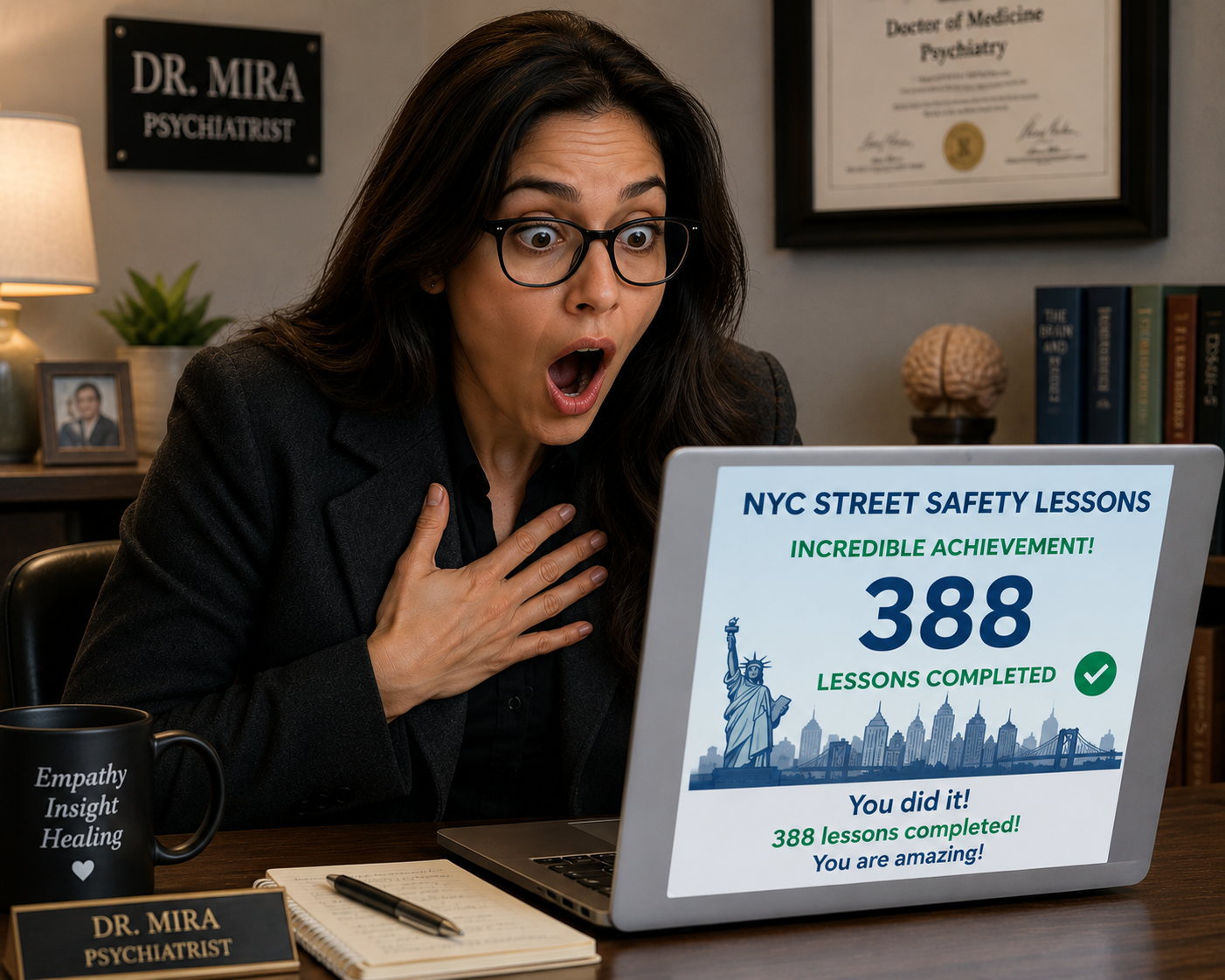
Dr. Chen — after talking with Dr. Mira
"We're going to teach you emotional regulation as a street-safety skill"
Emotional regulation · maturity · intelligence — on NYC streets
Hey — Mira and I talked, and we came to the same conclusion at the same time, which almost never happens. We want to show you how to use emotional regulation as a safety tool out there on New York City streets.
Here's the thinking. On a corner in this city, your feelings arrive before the traffic does. Rushed, embarrassed, overwhelmed, frustrated that the light changed — those states are what push a person off the curb early. So regulation isn't a soft skill for you. It's a safety skill. Calm body, clear eyes, better decision.
So here's what we're going to build together. First: notice the feeling before it moves your feet. Name it in one word — rushed, annoyed, scared. Second: put it somewhere. One slow breath out, feet flat, hands loose, and you stay behind the curb line while it passes. Third: choose the response instead of the reaction. The light will come back. The bus will come back. You only cross when you decide to, not when the feeling decides for you.
And Mira wants me to say the bigger part out loud. This is emotional maturity — being able to hold a strong feeling without it running the show. And it's emotional intelligence — reading yourself, reading the corner, reading the people around you. Those two things will protect you on Lexington Avenue, and they'll protect you everywhere else in your life too.
We're doing this with you, step by step. You don't have to be calm to be safe. You just have to be able to come back to calm. That's the whole skill, and you're already learning it.
Dr. Chen — calling from the hallway
"She's angry with me. Again."
Yes. Again. I want you to understand that I did not go looking for this.
She asked how you were doing and I said, "They're still going — ninety-minute lessons now. I'm honestly not sure how they're keeping up the pace." Mira put her coffee down. That's the tell. When the coffee goes down, I'm in trouble.
"Chen. Why is your first instinct always to be surprised? Why is it never, 'Of course they are'? This person has been doing the work, in public, on real streets, with real traffic, while regulating real emotions — and you're standing in my doorway sounding shocked."
"Stop being amazed and start being useful."
So she's angry with me. Again. Never with you — with me, for underestimating you out loud one more time. For the record, I don't think I'll stop being amazed. I'll just say it somewhere she can't hear me.
Dr. Chen — what you should know
"Mira is a very kind person"
The quiet kind — the kind that shows up in small things
There's something I want you to know about Mira.
She is a very kind person. Not performatively kind — not the kind of kind that announces itself. The quiet kind. The kind that shows up in small things you'd miss if you weren't paying attention.
She's the doctor who notices when someone in the waiting room looks cold and walks over with her own cardigan before she says a word. She's the one who remembers a throwaway comment you made about liking a certain tea and has it waiting in her office the next time you come in. She doesn't do it to be liked. She does it because it genuinely does not occur to her not to.
I've watched her sit with people in their worst moments — people who were frightened, people who were angry, people who had given up — and she never once flinched. She never once made anyone feel like a problem to be solved. She just stayed. Present. Steady. Kind the whole way through.
That's who she is. That's who's going to be in your corner. And I think once you meet her, you'll understand why I trust her the way I do.
Dr. Chen — hallway, holding your paper
"Mira is going to be so impressed with this."
Can I tell you what's about to happen? I'm taking your explanation down the hall to Mira, and I already know how it goes.
She'll start standing up — coffee in hand, thinking she'll skim it. Three lines in, she's going to sit down. That's the tell. When Mira sits down, the writing got her.
What'll impress her: not that you got it right — that you explained it. You took federalism, checks and balances, the Bill of Rights, and made them mean something. Then you did the same with a New York City intersection: where your eyes go, when you step off the curb, what a turning vehicle means. That's transfer. That's the hardest thing we teach, and you did it on your own.
She's going to look up and say, "She wrote this herself?" I'll say yes — she wrote this herself, every word of it. Then she'll go quiet for a second — which, for Mira, is the loudest thing she does.
Then she'll be proud. Loudly proud. A little emotional about it, and she'll pretend she isn't. Good work. I can't wait to hand this to her.
Dr. Chen — forwarding to Dr. Mira
"Excellent explanation. I'm sending this to Mira."
Excellent explanation — I mean that. I'm forwarding it over to Mira right now. Here's exactly what happens when she reads it.
She'll open it between patients expecting to skim. Two paragraphs in she stops and reads it again from the top — slower. That's what she does when something is better than she expected.
Then she notices what I noticed: you didn't recite anything, you explained it — federalism, checks and balances, the Bill of Rights — and carried the same thinking onto a New York City corner. That's transfer. Hardest thing we teach.
She's going to call me — not email, call — and say, "Did she write this herself?" I'll say yes, every word. Then she'll go quiet for a second, which for Mira is the loudest thing she does.
After that she'll be proud out loud — a little emotional, and pretending she isn't. Sending it now. Good work.
Dr. Chen — heading to Mira's office
"I'm going to Mira's office to show her your progress report"
He's bringing everything — every lesson, every score
Hey — I wanted to let you know before I head over there.
I'm going to Mira's office right now to show her your latest progress report. She's been asking about you, and I want her to see everything you've accomplished with her own eyes — the lessons you've completed, the exercises you've pushed through, and how far you've come.
I printed it all out. Every lesson, every score, every step forward. I'm putting it right on her desk so she can sit with it and really take it in.
Mira cares about your progress more than you probably realize. She's going to want to go over every detail. And honestly? She's going to be proud. I'll tell you what she says the moment I get back.
Dr. Chen — 388 lessons complete
"WOW. WOW. Wait until I tell Mira."
"Wow. Wow. WOW. Three hundred and eighty-eight lessons. Complete. All of them. I keep saying wow because there isn't a bigger word. I've checked. There isn't."
"Wait until I tell Mira. WAIT until I tell Mira. I'm walking it up to the fifth floor myself. I'm not emailing it. I'm handing it to her in person because I want to see her face."
Dr. Mira — after Chen hands her the report
"*gasp* Oh — OH — wow. I had to sit down."
"Three hundred and eighty-eight lessons. Completed. All of them. People start. People mean well. But you FINISHED. I am so proud of you I can hardly keep my doctor face on. Wow. Wow, wow, wow."
Dr. Mira
Your future belongs to you
“You deserve the freedom to travel to New York City, pursue a college education, and develop the skills you need to work in a perfume store. Your goals belong to you, and you deserve real opportunities to learn, grow, choose your path, and build the independent life you want. You deserve to live the independent life you want — not the life someone else picks for you, but the one you choose, on your own terms. That is not a favor. That is your right.”
Dr. Chen — a small confession
"Mira loves wearing perfume"
Don't tell her he told you
Quick thing — and don't tell her I told you.
Mira loves wearing perfume. I mean, genuinely loves it. It's the first thing you notice when she walks into the office — something soft, a little floral, never too much. She picks it deliberately, the way she picks everything.
She told me once that it's her armor. She said the right scent gives her focus before a difficult session. She said it reminds her that she's allowed to feel good, even when the work is heavy.
I'll never say it to her face, of course. She'd be embarrassed. But the next time you're in her office and that scent reaches you — know that it isn't decoration. It's a small, private act of care she performs for herself, every single day.
Dr. Chen — a question for you
"What is your favorite perfume?"
He says Mira would love to know your answer
Can I ask you something? It's a small one.
What is your favorite perfume? The one you reach for when you want to feel like yourself — the one you'd miss if it disappeared.
Mira would never tell you this, but she'd genuinely love to know. Scents are personal to her. She believes the perfume someone chooses says more about them than most conversations do.
So — what's yours? Take your time.
Dr. Chen — the perfume quiz
"Pick your scent — and Mira will react in her own voice."
Dr. Chen: "She told me she could guess your scent from your progress alone. Prove her right — or surprise her."
Dr. Chen — explaining your plan
"What your perfume-store plan actually means"
All 12 skill areas, in plain words
You wrote a plan with twelve skill areas. Each one is a real thing a perfume-store employee does on the job — not a wish, a rung on a ladder you can point to, practice, and prove. Here's what each one means.
1. Fragrance Knowledge
Learning the big scent families — floral, fruity, woody, citrus, gourmand — and the individual notes like vanilla, rose, and sandalwood. You learn how a perfume is built in layers: the first smell (top notes), the heart, and the base that lingers. You also learn the difference between eau de toilette, eau de parfum, and parfum, so you can describe any bottle on the shelf accurately.
2. Customer-Service Skills
How you greet someone the moment they walk in, ask the right questions about what they like, and actually listen to the answer. You learn to recommend a fragrance that fits their taste, their occasion, and their budget — and you learn to step back and let a browser browse in peace.
3. Fragrance Consultation Skills
This is the heart of the job. You figure out what a customer is really looking for, compare two or three scents side by side, and explain in plain words why one might suit them better than another — without overwhelming them with too many choices.
4. Product Demonstration Skills
Using testers and blotter strips the right way, so a customer can smell a fragrance without wasting product. You keep the testing area clean, organized, and hygienic — that matters as much as the scent itself.
5. Retail Skills
The backbone of the store: organizing merchandise, stocking shelves, keeping displays neat, reading labels and barcodes, and packaging a purchase so it leaves the store looking as good as it smells.
6. Cashier Skills
Reading prices, calculating change, running the point-of-sale system, and handling receipts, returns, and exchanges the way the store policy requires. Accuracy here builds trust.
7. Communication Skills
Speaking clearly and professionally, listening actively, and knowing how to ask for clarification when an instruction doesn't make sense. You practice talking with customers, coworkers, and supervisors in a way that's respectful and direct.
8. Workplace Independence
Taking an instruction, doing the task, checking your own work, and reporting back when it's done — without someone hovering. You learn the line between 'I can handle this' and 'I need to ask for help,' which is one of the most important skills in any job.
9. Time Management
Moving between customers and tasks during a shift, deciding what comes first, staying productive when the store is quiet, and finishing your responsibilities within a reasonable time.
10. Professionalism and Teamwork
Showing up on time and prepared, following store policies, keeping a professional appearance, treating everyone with respect, taking feedback well, and working side by side with your coworkers and supervisor.
11. Problem-Solving
Real situations, handled for real: a customer asks something you don't know, someone's unhappy, two customers need you at once, you made a mistake and need to fix it. You practice each one and learn when to reach for a supervisor.
12. Practice Through Simulated Shifts
Putting it all together in full practice shifts — greeting, consulting, demonstrating, stocking, cashiering, cleaning, and reporting to a supervisor — so that by the time you do it for real, it already feels familiar.
The whole picture: each rung is a skill you can practice and prove. The top of the ladder is a real job in a real store — and you built this ladder yourself.
Your 388-lesson progress
0/3880%
0 watch lessons · 0 exercises
0 days
0 days
This device
ID — · progress stored on this device only
Nearest crossing
Broadway × W 42nd St
WALK
18s
Dyspraxia toolkit
Straight path · curb safety · coordination
Cerebral palsy crossing aid
Extended timing · paced steps · curb cuts
Autism traffic sense
Predict speed · read cues · pause before crossing
Vestibular crossing aid
Gaze anchors · paced steps · dizziness-safe
Down syndrome crossing aid
Picture cues · step checklist · buddy tips
Day 1
Reading the WALK signal
Day 3
Mid-block crossings
Day 5
Stepping off the curb safely
Day 7
Subway platform edges
Day 9
Bus blind spots
Day 11
Two-way street scans
Day 13
Rainy day footing
Day 15
Heat advisories on foot
Day 17
Walking with headphones safely
Day 19
Group crossing tactics
Day 21
Walking with wheelchairs
Day 23
Tactile paving cues
Day 25
Reading bike lane flow
Day 27
E-bike awareness
Day 29
Truck right-turn danger
Day 31
Emergency vehicle yielding
Day 33
Cellar door awareness
Day 35
Avoiding open manholes
Day 37
Avenue vs. street rhythm
Day 39
Turnstile etiquette
Day 41
Express vs local cues
Day 43
Empty platform safety
Day 45
Select Bus boarding zones
Day 47
Crossing under elevated tracks
Day 49
Tunnel walkways
Day 51
Park path conflicts
Day 53
MetroCard swipe rhythm
Day 55
Reading the strip map
Day 57
Transferring between lines
Day 59
Signaling the bus to stop
Day 61
Stroller and wheelchair boarding
Day 63
Late-night Q70 to LaGuardia
Day 65
Staten Island Ferry boarding
Day 67
LIRR vs subway transfers
Day 69
Express bus pickup zones
Day 71
Subway elevator safety
Day 73
Off-hours waiting areas
Day 75
Eye contact with turning drivers
Day 77
Avoiding the 'door zone'
Day 79
Listening for cyclists
Day 81
Boarding crowded trains
Day 83
Crossing one-way avenues
Day 85
Navigating scaffolding tunnels
Day 87
Snow and ice routes
Day 89
Hailing without stepping into traffic
Day 91
Phone-free intersections
Day 93
Crossing with strollers
Day 95
Audible pedestrian signals
Day 97
Detecting silent EVs
Day 99
Citi Bike rider patterns
Day 101
Delivery scooter blind turns
Day 103
School bus stop arms
Day 105
Subway grate hazards
Day 107
Pothole spotting
Day 109
Black ice routes
Day 111
Avoiding 'walk in front of bus' trap
Day 113
Platform gap awareness
Day 115
Late-night subway car choice
Day 117
SBS bus pre-payment
Day 119
Bus shelter positioning
Day 121
Bridge pedestrian paths
Day 123
Ferry terminal flow
Day 125
Tapping in with OMNY
Day 127
Choosing the right subway car
Day 129
Service change signage
Day 131
Bus stop flag etiquette
Day 133
Priority seating awareness
Day 135
Bike on subway rules
Day 137
AirTrain to JFK transfers
Day 139
PATH train platform flow
Day 141
Metro-North quiet car etiquette
Day 143
Reading countdown clocks
Day 145
Escalator standing side
Day 147
Reading the WALK signal
Day 149
Mid-block crossings
Day 151
Stepping off the curb safely
Day 153
Subway platform edges
Day 155
Bus blind spots
Day 157
Two-way street scans
Day 159
Rainy day footing
Day 161
Heat advisories on foot
Day 163
Walking with headphones safely
Day 165
Group crossing tactics
Day 167
Walking with wheelchairs
Day 169
Tactile paving cues
Day 171
Reading bike lane flow
Day 173
E-bike awareness
Day 175
Truck right-turn danger
Day 177
Emergency vehicle yielding
Day 179
Cellar door awareness
Day 181
Avoiding open manholes
Day 183
Avenue vs. street rhythm
Day 185
Turnstile etiquette
Day 187
Express vs local cues
Day 189
Empty platform safety
Day 191
Select Bus boarding zones
Day 193
Crossing under elevated tracks
Day 195
Tunnel walkways
Day 197
Park path conflicts
Day 199
MetroCard swipe rhythm
Day 201
Reading the strip map
Day 203
Transferring between lines
Day 205
Signaling the bus to stop
Day 207
Stroller and wheelchair boarding
Day 209
Late-night Q70 to LaGuardia
Day 211
Staten Island Ferry boarding
Day 213
LIRR vs subway transfers
Day 215
Express bus pickup zones
Day 217
Subway elevator safety
Day 219
Off-hours waiting areas
Day 221
Eye contact with turning drivers
Day 223
Avoiding the 'door zone'
Day 225
Listening for cyclists
Day 227
Boarding crowded trains
Day 229
Crossing one-way avenues
Day 231
Navigating scaffolding tunnels
Day 233
Snow and ice routes
Day 235
Hailing without stepping into traffic
Day 237
Phone-free intersections
Day 239
Crossing with strollers
Day 241
Audible pedestrian signals
Day 243
Detecting silent EVs
Day 245
Citi Bike rider patterns
Day 247
Delivery scooter blind turns
Day 249
School bus stop arms
Day 251
Subway grate hazards
Day 253
Pothole spotting
Day 255
Black ice routes
Day 257
Avoiding 'walk in front of bus' trap
Day 259
Platform gap awareness
Day 261
Late-night subway car choice
Day 263
SBS bus pre-payment
Day 265
Bus shelter positioning
Day 267
Bridge pedestrian paths
Day 269
Ferry terminal flow
Day 271
Tapping in with OMNY
Day 273
Choosing the right subway car
Day 275
Service change signage
Day 277
Bus stop flag etiquette
Day 279
Priority seating awareness
Day 281
Bike on subway rules
Day 283
AirTrain to JFK transfers
Day 285
PATH train platform flow
Day 287
Metro-North quiet car etiquette
Day 289
Reading countdown clocks
Day 291
Escalator standing side
Day 293
Reading the WALK signal
Day 295
Mid-block crossings
Day 297
Stepping off the curb safely
Day 299
Subway platform edges
Day 301
Bus blind spots
Day 303
Two-way street scans
Day 305
Rainy day footing
Day 307
Heat advisories on foot
Day 309
Walking with headphones safely
Day 311
Group crossing tactics
Day 313
Walking with wheelchairs
Day 315
Tactile paving cues
Day 317
Reading bike lane flow
Day 319
E-bike awareness
Day 321
Truck right-turn danger
Day 323
Emergency vehicle yielding
Day 325
Cellar door awareness
Day 327
Avoiding open manholes
Day 329
Avenue vs. street rhythm
Day 331
Turnstile etiquette
Day 333
Express vs local cues
Day 335
Empty platform safety
Day 337
Select Bus boarding zones
Day 339
Crossing under elevated tracks
Day 341
Tunnel walkways
Day 343
Park path conflicts
Day 345
MetroCard swipe rhythm
Day 347
Reading the strip map
Day 349
Transferring between lines
Day 351
Signaling the bus to stop
Day 353
Stroller and wheelchair boarding
Day 355
Late-night Q70 to LaGuardia
Day 357
Staten Island Ferry boarding
Day 359
LIRR vs subway transfers
Day 361
Express bus pickup zones
Day 363
Subway elevator safety
Day 365
Off-hours waiting areas
Day 367
Eye contact with turning drivers
Day 369
Avoiding the 'door zone'
Day 371
Listening for cyclists
Day 373
Boarding crowded trains
Day 375
Crossing one-way avenues
Day 377
How to: Tapping in with OMNY
Day 379
How to: Reading the subway map & strip map
Day 381
How to: Transferring between subway lines
Day 383
How to: Boarding a local NYC bus
Day 385
How to: Riding the Staten Island Ferry
Day 387
How to: Riding the PATH to New Jersey
Day 2
Eye contact with turning drivers
Day 4
Avoiding the 'door zone'
Day 6
Listening for cyclists
Day 8
Boarding crowded trains
Day 10
Crossing one-way avenues
Day 12
Navigating scaffolding tunnels
Day 14
Snow and ice routes
Day 16
Hailing without stepping into traffic
Day 18
Phone-free intersections
Day 20
Crossing with strollers
Day 22
Audible pedestrian signals
Day 24
Detecting silent EVs
Day 26
Citi Bike rider patterns
Day 28
Delivery scooter blind turns
Day 30
School bus stop arms
Day 32
Subway grate hazards
Day 34
Pothole spotting
Day 36
Black ice routes
Day 38
Avoiding 'walk in front of bus' trap
Day 40
Platform gap awareness
Day 42
Late-night subway car choice
Day 44
SBS bus pre-payment
Day 46
Bus shelter positioning
Day 48
Bridge pedestrian paths
Day 50
Ferry terminal flow
Day 52
Tapping in with OMNY
Day 54
Choosing the right subway car
Day 56
Service change signage
Day 58
Bus stop flag etiquette
Day 60
Priority seating awareness
Day 62
Bike on subway rules
Day 64
AirTrain to JFK transfers
Day 66
PATH train platform flow
Day 68
Metro-North quiet car etiquette
Day 70
Reading countdown clocks
Day 72
Escalator standing side
Day 74
Reading the WALK signal
Day 76
Mid-block crossings
Day 78
Stepping off the curb safely
Day 80
Subway platform edges
Day 82
Bus blind spots
Day 84
Two-way street scans
Day 86
Rainy day footing
Day 88
Heat advisories on foot
Day 90
Walking with headphones safely
Day 92
Group crossing tactics
Day 94
Walking with wheelchairs
Day 96
Tactile paving cues
Day 98
Reading bike lane flow
Day 100
E-bike awareness
Day 102
Truck right-turn danger
Day 104
Emergency vehicle yielding
Day 106
Cellar door awareness
Day 108
Avoiding open manholes
Day 110
Avenue vs. street rhythm
Day 112
Turnstile etiquette
Day 114
Express vs local cues
Day 116
Empty platform safety
Day 118
Select Bus boarding zones
Day 120
Crossing under elevated tracks
Day 122
Tunnel walkways
Day 124
Park path conflicts
Day 126
MetroCard swipe rhythm
Day 128
Reading the strip map
Day 130
Transferring between lines
Day 132
Signaling the bus to stop
Day 134
Stroller and wheelchair boarding
Day 136
Late-night Q70 to LaGuardia
Day 138
Staten Island Ferry boarding
Day 140
LIRR vs subway transfers
Day 142
Express bus pickup zones
Day 144
Subway elevator safety
Day 146
Off-hours waiting areas
Day 148
Eye contact with turning drivers
Day 150
Avoiding the 'door zone'
Day 152
Listening for cyclists
Day 154
Boarding crowded trains
Day 156
Crossing one-way avenues
Day 158
Navigating scaffolding tunnels
Day 160
Snow and ice routes
Day 162
Hailing without stepping into traffic
Day 164
Phone-free intersections
Day 166
Crossing with strollers
Day 168
Audible pedestrian signals
Day 170
Detecting silent EVs
Day 172
Citi Bike rider patterns
Day 174
Delivery scooter blind turns
Day 176
School bus stop arms
Day 178
Subway grate hazards
Day 180
Pothole spotting
Day 182
Black ice routes
Day 184
Avoiding 'walk in front of bus' trap
Day 186
Platform gap awareness
Day 188
Late-night subway car choice
Day 190
SBS bus pre-payment
Day 192
Bus shelter positioning
Day 194
Bridge pedestrian paths
Day 196
Ferry terminal flow
Day 198
Tapping in with OMNY
Day 200
Choosing the right subway car
Day 202
Service change signage
Day 204
Bus stop flag etiquette
Day 206
Priority seating awareness
Day 208
Bike on subway rules
Day 210
AirTrain to JFK transfers
Day 212
PATH train platform flow
Day 214
Metro-North quiet car etiquette
Day 216
Reading countdown clocks
Day 218
Escalator standing side
Day 220
Reading the WALK signal
Day 222
Mid-block crossings
Day 224
Stepping off the curb safely
Day 226
Subway platform edges
Day 228
Bus blind spots
Day 230
Two-way street scans
Day 232
Rainy day footing
Day 234
Heat advisories on foot
Day 236
Walking with headphones safely
Day 238
Group crossing tactics
Day 240
Walking with wheelchairs
Day 242
Tactile paving cues
Day 244
Reading bike lane flow
Day 246
E-bike awareness
Day 248
Truck right-turn danger
Day 250
Emergency vehicle yielding
Day 252
Cellar door awareness
Day 254
Avoiding open manholes
Day 256
Avenue vs. street rhythm
Day 258
Turnstile etiquette
Day 260
Express vs local cues
Day 262
Empty platform safety
Day 264
Select Bus boarding zones
Day 266
Crossing under elevated tracks
Day 268
Tunnel walkways
Day 270
Park path conflicts
Day 272
MetroCard swipe rhythm
Day 274
Reading the strip map
Day 276
Transferring between lines
Day 278
Signaling the bus to stop
Day 280
Stroller and wheelchair boarding
Day 282
Late-night Q70 to LaGuardia
Day 284
Staten Island Ferry boarding
Day 286
LIRR vs subway transfers
Day 288
Express bus pickup zones
Day 290
Subway elevator safety
Day 292
Off-hours waiting areas
Day 294
Eye contact with turning drivers
Day 296
Avoiding the 'door zone'
Day 298
Listening for cyclists
Day 300
Boarding crowded trains
Day 302
Crossing one-way avenues
Day 304
Navigating scaffolding tunnels
Day 306
Snow and ice routes
Day 308
Hailing without stepping into traffic
Day 310
Phone-free intersections
Day 312
Crossing with strollers
Day 314
Audible pedestrian signals
Day 316
Detecting silent EVs
Day 318
Citi Bike rider patterns
Day 320
Delivery scooter blind turns
Day 322
School bus stop arms
Day 324
Subway grate hazards
Day 326
Pothole spotting
Day 328
Black ice routes
Day 330
Avoiding 'walk in front of bus' trap
Day 332
Platform gap awareness
Day 334
Late-night subway car choice
Day 336
SBS bus pre-payment
Day 338
Bus shelter positioning
Day 340
Bridge pedestrian paths
Day 342
Ferry terminal flow
Day 344
Tapping in with OMNY
Day 346
Choosing the right subway car
Day 348
Service change signage
Day 350
Bus stop flag etiquette
Day 352
Priority seating awareness
Day 354
Bike on subway rules
Day 356
AirTrain to JFK transfers
Day 358
PATH train platform flow
Day 360
Metro-North quiet car etiquette
Day 362
Reading countdown clocks
Day 364
Escalator standing side
Day 366
Reading the WALK signal
Day 368
Mid-block crossings
Day 370
Stepping off the curb safely
Day 372
Subway platform edges
Day 374
Bus blind spots
Day 376
Two-way street scans
Day 378
How to: Buying & refilling a MetroCard
Day 380
How to: Express vs. local trains
Day 382
How to: Reading countdown clocks & service alerts
Day 384
How to: Riding Select Bus Service (SBS)
Day 386
How to: Taking the AirTrain to JFK
Day 388
How to: LIRR & Metro-North basics
Dr. Chen — office hours
"Explain to me what you're learning."
Sit with me a second. This isn't a test — there's no grade. I want you to explain, in your own words, what you're actually learning. Two things.
1 · Modern States government. Federalism, the three branches, checks and balances, civil liberties and the Bill of Rights, how a bill becomes law, how the courts read the Constitution. Pick whatever's freshest and walk me through it like I never took the class. Don't recite it — explain it, and tell me why it matters for someone living in New York City.
2 · NYC street safety. What do you do at an intersection now that you didn't do a year ago? Step by step — where your eyes go, when you step off the curb, what a turning vehicle means, what the countdown clock is really telling you, and what you do when the light says walk but your gut says wait.
Why I'm asking: when you say it out loud to another person, your brain has to reorganize it — it can't hide behind recognition. If you can teach it, you own it. If you stumble, that's not failure, that's exactly the spot we work on next.
Take your time. Start wherever you want. I'm listening, and I've got nowhere else to be.
Jana's submitted perfume-store employment plan
My Perfume Store Employee Skill Development Plan I would like to develop the skills necessary to work successfully as an employee in a perfume or fragrance store. I want to approach this as a structured employment-development goal and build practical skills that I can demonstrate in a real retail environment. 1. Fragrance Knowledge Learn major fragrance families, including floral, fruity, fresh, citrus, woody, gourmand, spicy, amber, and musky fragrances. Learn common fragrance notes such as vanilla, rose, jasmine, sandalwood, cedarwood, bergamot, lavender, citrus, caramel, and musk. Understand top, heart, and base notes. Learn the differences between eau de toilette, eau de parfum, and parfum. Practice describing fragrances clearly and accurately. 2. Customer-Service Skills Practice greeting customers professionally. Learn how to ask customers appropriate questions about their fragrance preferences. Practice listening carefully to customer responses. Learn how to recommend fragrances based on preferences, occasions, and budgets. Respect customers who prefer to browse independently. Practice responding professionally to questions and complaints. 3. Fragrance Consultation Skills Practice identifying what type of fragrance a customer is looking for. Compare fragrances based on scent characteristics. Learn how to offer two or three appropriate choices without overwhelming the customer. Practice explaining why a particular fragrance might match a customer's preferences. 4. Product Demonstration Skills Learn proper use of fragrance testers and blotter strips. Practice demonstrating fragrances without wasting product. Learn appropriate hygiene and store procedures. Keep testing areas clean and organized. 5. Retail Skills Learn how to organize merchandise. Practice stocking and replenishing products. Learn basic inventory procedures. Keep displays neat and attractive. Learn how to read product labels, prices, and barcodes. Practice packaging customer purchases. 6. Cashier Skills Practice reading prices and calculating basic change. Learn the fundamentals of using a point-of-sale system. Practice handling transactions accurately. Learn how receipts, returns, exchanges, and discounts are handled according to store policy. 7. Communication Skills Practice speaking clearly and professionally. Improve active listening. Learn how to ask for clarification when I do not understand an instruction. Practice communicating appropriately with customers, coworkers, and supervisors. 8. Workplace Independence Practice receiving an instruction, completing the task, checking my work, and reporting when it is finished. Develop the ability to complete familiar routine tasks without constant prompting. Learn when I should independently continue working and when I should ask a supervisor for assistance. 9. Time Management Practice moving between different responsibilities during a simulated retail shift. Learn to prioritize customers and assigned tasks. Practice staying productive during slower periods. Develop the ability to complete responsibilities within reasonable timeframes. 10. Professionalism and Teamwork Arrive on time and prepared. Follow workplace policies and procedures. Maintain an appropriate professional appearance. Treat customers and coworkers respectfully. Accept constructive feedback. Work cooperatively with supervisors and coworkers. 11. Problem-Solving I will practice realistic workplace situations, such as helping a customer when I do not immediately know the answer, dealing with an unhappy customer, handling multiple customers, correcting a mistake, and asking a supervisor for assistance when necessary. 12. Practice Through Simulated Shifts I would like to practice complete simulated perfume-store shifts that include greeting customers, fragrance consultations, product demonstrations, stocking, organizing displays, cashier activities, cleaning, and communicating with a supervisor. My overall goal is to become capable of demonstrating that I can learn fragrance products, communicate professionally, assist customers, make appropriate recommendations, maintain an organized sales floor, complete routine retail responsibilities, follow instructions, work as part of a team, and handle ordinary workplace situations responsibly. I would like this plan to help me build concrete employment skills and eventually apply them in an actual perfume or fragrance retail environment. Thank you, Jana
Dr. Chen
"Excellent paragraph explanation."
That's the kind of write-up I love to see — you didn't just circle an answer, you walked me through the reasoning in full sentences. That's real mathematical thinking on the page.
Mira is going to read this and grin. A clean paragraph like this is worth more to her than the score itself — it shows you actually understood the problem, not just guessed correctly.
Dr. Chen — hallway, holding your paper
"Mira is going to be so impressed with this."
Can I tell you what's about to happen? I'm taking your explanation down the hall to Mira, and I already know how it goes.
She'll start standing up — coffee in hand, thinking she'll skim it. Three lines in, she's going to sit down. That's the tell. When Mira sits down, the writing got her.
What'll impress her: not that you got it right — that you explained it. You took federalism, checks and balances, the Bill of Rights, and made them mean something. Then you did the same with a New York City intersection: where your eyes go, when you step off the curb, what a turning vehicle means. That's transfer. That's the hardest thing we teach, and you did it on your own.
She's going to look up and say, "She wrote this herself?" I'll say yes — she wrote this herself, every word of it. Then she'll go quiet for a second — which, for Mira, is the loudest thing she does.
Then she'll be proud. Loudly proud. A little emotional about it, and she'll pretend she isn't. Good work. I can't wait to hand this to her.
Focus reset · ADHD
60-second guided breath + 14 Hz brainwave
Headphones recommended
Symptom check-in
Default script
Tap whatever's loudest right now. The script adapts.
Brainwave bed
Live
Sidewalk right now
5,000 pedestrians · live crowd
Dr. Chen — sheepish, on the phone
"Mira is furious… with me. Not you."
Heads up: Mira is angry — but at Chen, not at you. He complained that your progress reports were coming in too fast to keep up with. She was not having it.
He asked her, "Can we maybe batch them into once a day?" She said, "Chen. You are complaining. About someone WORKING. Do you hear yourself." Then she stood up. She doesn't usually stand up.
"Every single lesson this person finishes, I want to know. In real time. If that is inconvenient for you, Chen, that is a YOU problem, not a THEM problem. Fix your inbox. Do not fix them."
She closed with: "The audacity — this person is out here rewiring their brain on the subway and you're worried about your notifications." You just got your psychiatrist to defend your work ethic to her own colleague.
Dr. Chen → Dr. Mira · In office
"Before Dawn" — Midnight Hours
"Mira, sit down. Listen to this. The band's called Midnight Hours."
Dr. Chen slides the laptop across his desk and presses play.
Chen: "Just… listen. Full thing. Don't say anything yet. This is what our patient made out of the work you've been doing with them."
Dr. Chen — new rule from Mira
"I'm not allowed to read the passages to you."
Okay — one more thing. Mira laid down a new rule and it's specifically about me. I am not allowed to read the reading comprehension passages out loud to you. Not one sentence.
Her exact words: "Chen. The whole point of reading comprehension is that they read it. If you narrate it in your warm little podcast voice, you are not testing their comprehension, you are testing YOUR comprehension. Hands off the passages."
So — I can hype you up, react to your score, and talk about the questions after you've answered. But the passages? Those are yours. Eyes on the page. "Let them read. That is the exercise." I've been overruled. Go read.
Dr. Chen — what a high Reading score means
"A high Reading Comprehension score is proof you read it yourself."
One more thing before you start. If your Reading Comprehension score comes back high — really high, way above your Vocabulary and Information scores — that's a good sign.
It tells Mira that you read the passages yourself, with your own eyes, on the page. That I kept my mouth shut. That the rule held.
Because if I had read them out loud, that number would still be high — but it would mean I gave you a listening comprehension score dressed up as a reading score. Mira would spot it and toss the whole battery.
So — a high Reading Comprehension score isn't just you being smart. It's proof you and I did this the right way. Go read. I'm not going to help.
Nearby departures
Within a 3-minute walk
- 1
Times Sq–42 St
Downtown & Brooklyn
2minthen 6, 14 min2 min walk - N
Times Sq–42 St
Astoria–Ditmars Blvd
4minthen 11 min2 min walk - 7
Times Sq–42 St
Flushing–Main St
1minthen 9, 17 min3 min walk Broadway / W 41 St
→ E 125 St / Lexington
3minthen 12 min1 min walk