Watch the clip.
Guess right or wrong.
388 daily lessons. Each one is a 90-minute video plus a quick safe-or-risky quiz.
iPhone and computer layout · All 388 lessons
Videos ← My employment plan → Videos
Dr. Chen — office hours
"Explain to me what you're learning."
Sit with me a second. This isn't a test — there's no grade. I want you to explain, in your own words, what you're actually learning. Two things.
1 · Modern States government. Federalism, the three branches, checks and balances, civil liberties and the Bill of Rights, how a bill becomes law, how the courts read the Constitution. Pick whatever's freshest and walk me through it like I never took the class. Don't recite it — explain it, and tell me why it matters for someone living in New York City.
2 · NYC street safety. What do you do at an intersection now that you didn't do a year ago? Step by step — where your eyes go, when you step off the curb, what a turning vehicle means, what the countdown clock is really telling you, and what you do when the light says walk but your gut says wait.
Why I'm asking: when you say it out loud to another person, your brain has to reorganize it — it can't hide behind recognition. If you can teach it, you own it. If you stumble, that's not failure, that's exactly the spot we work on next.
Take your time. Start wherever you want. I'm listening, and I've got nowhere else to be.
Jana's submitted perfume-store employment plan
My Perfume Store Employee Skill Development Plan I would like to develop the skills necessary to work successfully as an employee in a perfume or fragrance store. I want to approach this as a structured employment-development goal and build practical skills that I can demonstrate in a real retail environment. 1. Fragrance Knowledge Learn major fragrance families, including floral, fruity, fresh, citrus, woody, gourmand, spicy, amber, and musky fragrances. Learn common fragrance notes such as vanilla, rose, jasmine, sandalwood, cedarwood, bergamot, lavender, citrus, caramel, and musk. Understand top, heart, and base notes. Learn the differences between eau de toilette, eau de parfum, and parfum. Practice describing fragrances clearly and accurately. 2. Customer-Service Skills Practice greeting customers professionally. Learn how to ask customers appropriate questions about their fragrance preferences. Practice listening carefully to customer responses. Learn how to recommend fragrances based on preferences, occasions, and budgets. Respect customers who prefer to browse independently. Practice responding professionally to questions and complaints. 3. Fragrance Consultation Skills Practice identifying what type of fragrance a customer is looking for. Compare fragrances based on scent characteristics. Learn how to offer two or three appropriate choices without overwhelming the customer. Practice explaining why a particular fragrance might match a customer's preferences. 4. Product Demonstration Skills Learn proper use of fragrance testers and blotter strips. Practice demonstrating fragrances without wasting product. Learn appropriate hygiene and store procedures. Keep testing areas clean and organized. 5. Retail Skills Learn how to organize merchandise. Practice stocking and replenishing products. Learn basic inventory procedures. Keep displays neat and attractive. Learn how to read product labels, prices, and barcodes. Practice packaging customer purchases. 6. Cashier Skills Practice reading prices and calculating basic change. Learn the fundamentals of using a point-of-sale system. Practice handling transactions accurately. Learn how receipts, returns, exchanges, and discounts are handled according to store policy. 7. Communication Skills Practice speaking clearly and professionally. Improve active listening. Learn how to ask for clarification when I do not understand an instruction. Practice communicating appropriately with customers, coworkers, and supervisors. 8. Workplace Independence Practice receiving an instruction, completing the task, checking my work, and reporting when it is finished. Develop the ability to complete familiar routine tasks without constant prompting. Learn when I should independently continue working and when I should ask a supervisor for assistance. 9. Time Management Practice moving between different responsibilities during a simulated retail shift. Learn to prioritize customers and assigned tasks. Practice staying productive during slower periods. Develop the ability to complete responsibilities within reasonable timeframes. 10. Professionalism and Teamwork Arrive on time and prepared. Follow workplace policies and procedures. Maintain an appropriate professional appearance. Treat customers and coworkers respectfully. Accept constructive feedback. Work cooperatively with supervisors and coworkers. 11. Problem-Solving I will practice realistic workplace situations, such as helping a customer when I do not immediately know the answer, dealing with an unhappy customer, handling multiple customers, correcting a mistake, and asking a supervisor for assistance when necessary. 12. Practice Through Simulated Shifts I would like to practice complete simulated perfume-store shifts that include greeting customers, fragrance consultations, product demonstrations, stocking, organizing displays, cashier activities, cleaning, and communicating with a supervisor. My overall goal is to become capable of demonstrating that I can learn fragrance products, communicate professionally, assist customers, make appropriate recommendations, maintain an organized sales floor, complete routine retail responsibilities, follow instructions, work as part of a team, and handle ordinary workplace situations responsibly. I would like this plan to help me build concrete employment skills and eventually apply them in an actual perfume or fragrance retail environment. Thank you, Jana
Dr. Chen
"Excellent paragraph explanation."
That's the kind of write-up I love to see — you didn't just circle an answer, you walked me through the reasoning in full sentences. That's real mathematical thinking on the page.
Mira is going to read this and grin. A clean paragraph like this is worth more to her than the score itself — it shows you actually understood the problem, not just guessed correctly.
Dr. Chen — hallway, holding your paper
"Mira is going to be so impressed with this."
Can I tell you what's about to happen? I'm taking your explanation down the hall to Mira, and I already know how it goes.
She'll start standing up — coffee in hand, thinking she'll skim it. Three lines in, she's going to sit down. That's the tell. When Mira sits down, the writing got her.
What'll impress her: not that you got it right — that you explained it. You took federalism, checks and balances, the Bill of Rights, and made them mean something. Then you did the same with a New York City intersection: where your eyes go, when you step off the curb, what a turning vehicle means. That's transfer. That's the hardest thing we teach, and you did it on your own.
She's going to look up and say, "She wrote this herself?" I'll say yes — she wrote this herself, every word of it. Then she'll go quiet for a second — which, for Mira, is the loudest thing she does.
Then she'll be proud. Loudly proud. A little emotional about it, and she'll pretend she isn't. Good work. I can't wait to hand this to her.
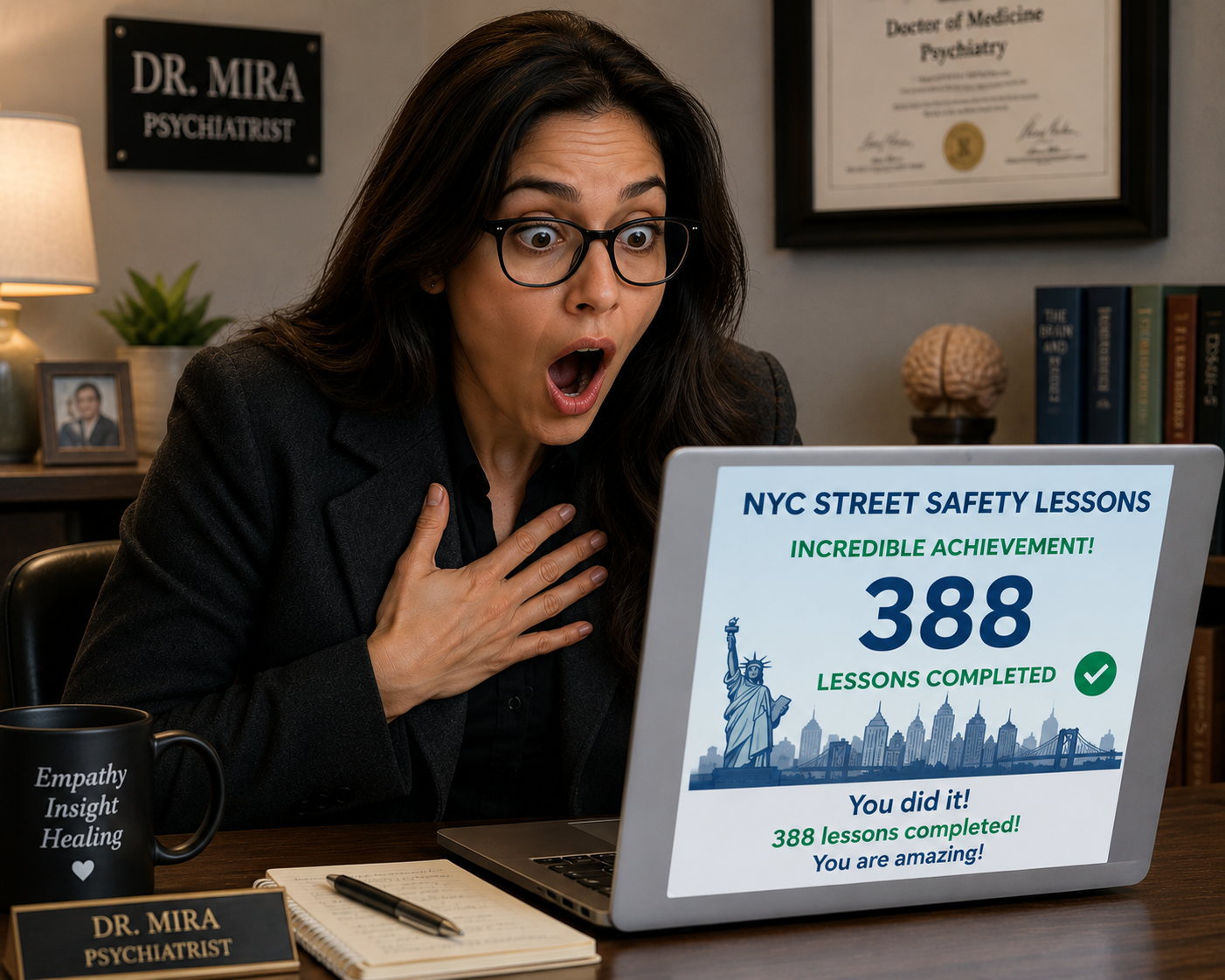
Bonus · Finish-day preview
Go see Dr. Mira's reaction after all 388 lessons →
0 / 388 lessons
0%
0in a row
Current streak
0
Best run
By course
- Accessibility0 / 34
- Bus Awareness0 / 34
- Construction Zones0 / 34
- Crossings0 / 35
- Crowd Navigation0 / 34
- Cyclist Avoidance0 / 34
- Emergency Response0 / 34
- Night Walking0 / 34
- Public Transit0 / 46
- Subway Safety0 / 35
- Weather & Visibility0 / 34
388 lessons
Dr. Chen — explaining your plan
"What your perfume-store plan actually means"
All 12 skill areas, in plain words
You wrote a plan with twelve skill areas. Each one is a real thing a perfume-store employee does on the job — not a wish, a rung on a ladder you can point to, practice, and prove. Here's what each one means.
1. Fragrance Knowledge
Learning the big scent families — floral, fruity, woody, citrus, gourmand — and the individual notes like vanilla, rose, and sandalwood. You learn how a perfume is built in layers: the first smell (top notes), the heart, and the base that lingers. You also learn the difference between eau de toilette, eau de parfum, and parfum, so you can describe any bottle on the shelf accurately.
2. Customer-Service Skills
How you greet someone the moment they walk in, ask the right questions about what they like, and actually listen to the answer. You learn to recommend a fragrance that fits their taste, their occasion, and their budget — and you learn to step back and let a browser browse in peace.
3. Fragrance Consultation Skills
This is the heart of the job. You figure out what a customer is really looking for, compare two or three scents side by side, and explain in plain words why one might suit them better than another — without overwhelming them with too many choices.
4. Product Demonstration Skills
Using testers and blotter strips the right way, so a customer can smell a fragrance without wasting product. You keep the testing area clean, organized, and hygienic — that matters as much as the scent itself.
5. Retail Skills
The backbone of the store: organizing merchandise, stocking shelves, keeping displays neat, reading labels and barcodes, and packaging a purchase so it leaves the store looking as good as it smells.
6. Cashier Skills
Reading prices, calculating change, running the point-of-sale system, and handling receipts, returns, and exchanges the way the store policy requires. Accuracy here builds trust.
7. Communication Skills
Speaking clearly and professionally, listening actively, and knowing how to ask for clarification when an instruction doesn't make sense. You practice talking with customers, coworkers, and supervisors in a way that's respectful and direct.
8. Workplace Independence
Taking an instruction, doing the task, checking your own work, and reporting back when it's done — without someone hovering. You learn the line between 'I can handle this' and 'I need to ask for help,' which is one of the most important skills in any job.
9. Time Management
Moving between customers and tasks during a shift, deciding what comes first, staying productive when the store is quiet, and finishing your responsibilities within a reasonable time.
10. Professionalism and Teamwork
Showing up on time and prepared, following store policies, keeping a professional appearance, treating everyone with respect, taking feedback well, and working side by side with your coworkers and supervisor.
11. Problem-Solving
Real situations, handled for real: a customer asks something you don't know, someone's unhappy, two customers need you at once, you made a mistake and need to fix it. You practice each one and learn when to reach for a supervisor.
12. Practice Through Simulated Shifts
Putting it all together in full practice shifts — greeting, consulting, demonstrating, stocking, cashiering, cleaning, and reporting to a supervisor — so that by the time you do it for real, it already feels familiar.
The whole picture: each rung is a skill you can practice and prove. The top of the ladder is a real job in a real store — and you built this ladder yourself.